
But it wasn’t an alarm.
It was freedom.
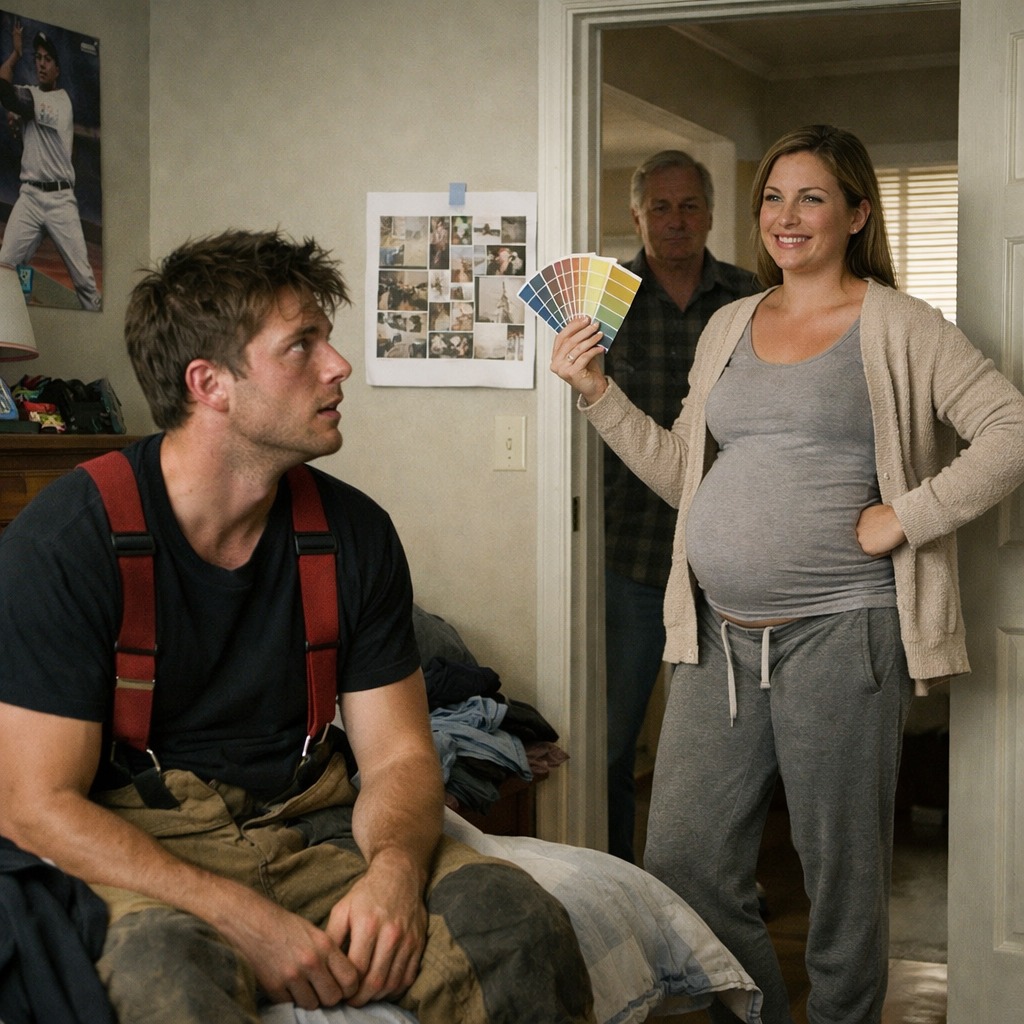
People asked me later if I regretted it—cutting them off, making things hard right when Emily was having a baby. And I always thought of that moment: Emily in my doorway smiling, already spending my life like it was hers. My dad shrugging like my survival was an inconvenience. The contractor asking who was paying.
Here’s what I learned:
You can run into burning buildings for strangers and still be set on fire by your own family.
But you don’t have to stand there and call it warmth.
I was still a firefighter. I still worked hard. I still helped people.
Just not the ones who thought love meant access.
And for the first time in my life, when I came home after a long shift—smoke in my hair, exhaustion in my bones—I had a door that stayed mine.
No one painted over it.
No one took it.
And if anyone ever told me figure it out, I finally knew the answer.
Because I already had.
The answer was simple, once you stopped pretending it was complicated:
You figure it out.
You don’t beg for a key to a house that keeps locking you out. You don’t keep paying rent for a room that can be erased with a Pinterest board. You don’t keep running into smoke for people who light the match and call it “love.”
You just… figure it out.
And I did.
But what nobody tells you—what they don’t put in the little inspirational quotes—is that once you stop being the family’s emergency fund, they treat it like a crime scene.
Because suddenly, their stability becomes your fault.
1
Two days after Officer Ramirez interviewed me, I got a certified letter.
The kind of envelope that feels heavy before you even open it.
Return address: a law firm in uptown Charlotte.
I stood in my tiny kitchen—one bedroom, worn carpet, garlic ghosts in the walls—holding it like it might bite me.
Louis was sitting on my couch in gym shorts eating cereal straight out of the box like my apartment was his second station. He glanced over and read my face.
“That’s either money or trouble,” he said.
“Same thing in my family,” I muttered, and tore it open.
It was a demand letter.
From Northridge Renovations’ legal department.
It said the contract was “executed” and that they’d incurred costs preparing to perform. They wanted compensation for “mobilization” and “materials acquisition.”
They wanted me to pay for a fraud my family tried to commit in my name.
I felt something in my chest go cold.
Louis leaned over, read the top paragraph, then whistled low.
“They’re trying to get you on the hook,” he said.
“I know.”
“You got the police report number?” he asked.
I nodded. “Took pictures. Screenshots. Everything.”
Louis pointed the cereal box like a weapon. “Then you call Ramirez back and you forward that letter to him. You don’t play.”
“I’m not playing,” I said, but my voice sounded too calm for what I felt.
Because the fear wasn’t about Northridge.
The fear was about the fact my family had now made my life something a courthouse could touch.
I called Ramirez, left a message, then forwarded the letter to the email he’d given me.
Ten minutes later, he called back.
His voice was steady, professional. “I saw it. Don’t respond directly. Forward everything to us. Also—your bank fraud department should send you a formal statement about the declined transaction attempt. We’ll want that.”
“Okay,” I said.
“You did the right thing coming in,” he added, and there was something almost human in his tone. “A lot of people don’t. They keep trying to fix it inside the family.”
I stared at the wall. “Yeah. Well. The family part doesn’t work if only one person believes in it.”
Ramirez paused. “I hear you.”
Then he said, “One more thing—don’t be surprised if they try to flip the narrative. People who do this don’t like consequences.”
I laughed once, sharp. “You mean like calling me selfish because I stopped them from stealing thirty-four grand?”
Ramirez didn’t laugh back. “Exactly like that.”
2
They didn’t wait long.
That weekend, Emily posted a long Facebook status with about eight paragraphs and an alarming amount of crying emojis.
She didn’t mention my name.
She didn’t mention the contract.
She didn’t mention the attempted $8,500 charge.
She just wrote vague, dramatic nonsense about how “some people” forget family when life gets hard, and how “pregnancy has shown her who really cares.”
Then she added a photo.
A photo of the paint samples.
Soft sage and warm oatmeal.
Like the paint itself was innocent.
The comments filled up fast.
Our aunt from Raleigh: Praying for you, sweet girl.
Our mom’s friend: People are so ungrateful these days.
Some stranger Emily met in a moms’ group: Cut toxic people OUT. Protect your peace, mama!
Protect your peace.
That phrase always makes me laugh now.
Because my family only cared about peace when it protected them.
When peace meant I stayed quiet. Paid the bills. Slept wherever they told me to sleep.
Louis sent me the screenshot with one line:
You want me to light her comments up?
I texted back:
No. Evidence, not arguments.
Because I’d learned something from fires.
You don’t scream at flames.
You starve them.
3
On Monday, my mom called from an unknown number.
I recognized her voice the second she said my name. It always had that soft wobble like she was holding tears in reserve.
“Max,” she whispered. “Please… we need to talk.”
I stared at the phone.
Louis was at my kitchen counter making instant ramen like he lived here permanently now.
I mouthed, It’s her.
Louis made a throat-slitting gesture. Don’t.
I should’ve listened.
But there’s something hardwired into you when you grow up in a house where love is conditional.
The part of you that still wants to believe this time will be different.
So I said, “What do you want, Mom?”
Her breath hitched like she’d been waiting for permission to collapse.
“We’re—” she started. “We’re scared.”
“With who?” I asked, and my voice came out flat.
“With the police,” she admitted quickly. “They called your father. They said they might come by. Max, why would you do that to us?”
I almost laughed.
Not because it was funny.
Because the audacity was so clean it felt unreal.
“Why would I do that?” I repeated. “Because you forged my signature, tried to charge my card, and put my name on a thirty-four-thousand-dollar contract.”
She made a small, wounded sound. “We didn’t forge—”
“Stop,” I said, and my voice sharpened. “You don’t get to play vocabulary games with me. Either I signed it or I didn’t.”
Silence.
Then she said, small and desperate: “Emily’s just… she’s overwhelmed.”
“Then Emily can be overwhelmed in a nursery she pays for,” I said.
My mom’s voice rose—panic turning into anger. “You’re punishing us!”
“No,” I said calmly. “I’m protecting myself.”
A beat.
Then she tried the old move—soft, guilt-wrapped, like she was tucking me back into the role.

Yo Make również polubił
Psy to coś więcej niż tylko zwierzęta domowe – to nasi najlepsi przyjaciele, lojalni obrońcy i członkowie rodziny.
Cytrynowe babeczki z mleczną polewą – przepis na puszyste i aromatyczne wypieki
Szok! Jogurtowe Placuszki Jabłkowe w 3 Minuty! Sekret Śniadaniowych Mistrzów Odkryty!
Wiosenne jajka