
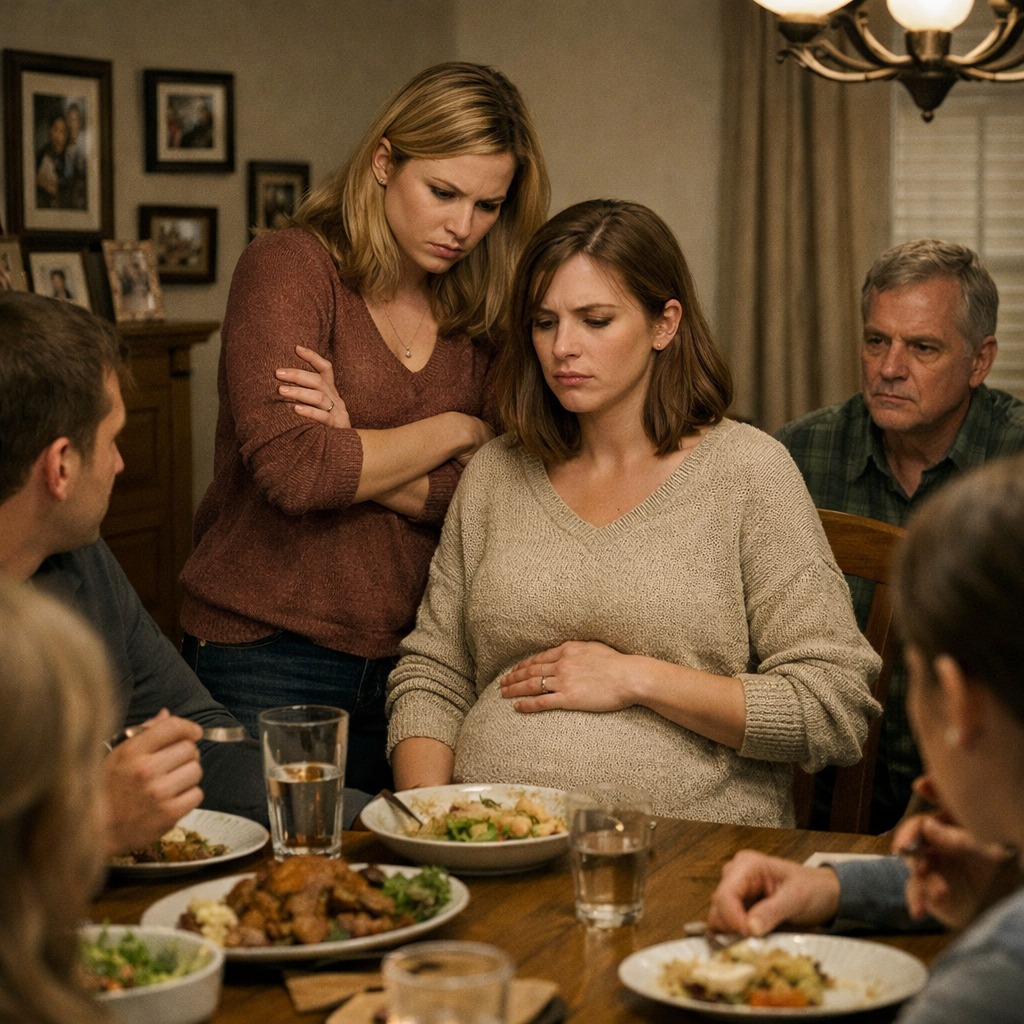
I let it go to voicemail.
He texted: Please answer. Your mother is falling apart.
Evan shook his head. “Not your job.”
But my heart still tugged—the old hook: be the good daughter, fix it, keep it calm.
So I answered on the next call.
“Hi,” I said, voice flat.
Dad sounded exhausted. “We need a family meeting,” he said. “We can’t—this can’t be the new normal.”
I took a breath. “I’ll meet with you,” I said, “but only with a therapist present. Neutral third party. And Aubrey is not invited.”
Silence.
Then Dad: “That feels extreme.”
I almost laughed.
“Extreme was the fake belly falling off during a police struggle,” I said quietly. “Extreme was a threat about pills in the punch bowl.”
Dad exhaled like he was trying to swallow his pride. “Okay,” he said finally. “Okay. We’ll do it your way.”
Then Mom grabbed the phone.
Her voice was thick with tears and rage.
“How could you do this to her?” she sobbed. “She needs us! She’s at her lowest point! And you’re—blocking her? Filing legal papers?”
I felt my heart rate jump.
Evan touched my shoulder, grounding me.
“Mom,” I said, steadying my voice the way my therapist had taught me in one emergency session. “I am pregnant. My blood pressure is elevated. I am not negotiating my safety to protect Aubrey from consequences.”
Mom inhaled sharply like I’d slapped her.
“You’re tearing the family apart,” she hissed.
“No,” I said. “I’m refusing to be the sacrifice.”
Then I ended the call before she could drag me into the old loop.
My hands shook afterward.
Evan wrapped his arms around me from behind and whispered, “That was you choosing the baby.”
And he was right.
The family therapy session happened the following Thursday.
My parents sat side by side like they were bracing for impact.
My mom’s eyes were red. My dad looked older than I’d ever seen him, like his denial had finally gotten heavy.
The therapist—Dr. Nguyen—started with ground rules.
No interruptions. No blaming. No “but she’s sick” as an excuse.
Then she asked me to speak.
I told them everything. Not just the baby shower.
The three months of secrecy. The missed wedding. The lies. The work promotion I’d declined because I couldn’t disclose my pregnancy. The way my own joy had been treated like a threat.
Then I said the part that made my dad flinch.
“You didn’t just protect Aubrey,” I said. “You trained me to disappear.”
My mom tried to interrupt.
Dr. Nguyen lifted a hand. “Let her finish.”
When I was done, there was a long silence.
My dad finally spoke.
“I… I didn’t realize,” he said, voice rough. “I thought we were preventing a breakdown.”
“You were,” I replied. “By creating one in me.”
My mom’s mouth tightened. “She’s struggled for years,” she said, defensive. “You don’t understand what it’s like to watch your child—”
“I am your child,” I said quietly.
That landed.
My dad’s eyes filled, and he looked away quickly like he hated that his body betrayed him.
Dr. Nguyen leaned forward. “Enabling is not love,” she said. “It is fear disguised as care.”
My mom’s shoulders shook. “We were scared,” she whispered.
“I know,” I said, softer now. “But your fear cost me. And it will not cost my child.”
We drafted a written agreement in that session—boundaries my parents had to follow if they wanted access to my life and my baby.
No passing messages from Aubrey.
No sharing updates about my pregnancy or labor.
No surprise Aubrey appearances.
Support group for families dealing with mental illness.
Accountability instead of cover-ups.
My dad signed immediately.
My mom signed like she was swallowing something bitter.
I didn’t feel victorious.
I felt… tired.
But it was the kind of tired you feel after lifting something heavy off your chest.
Then came the test.
Two Sundays later, I agreed to go to dinner at my parents’ house—carefully, cautiously, with Evan beside me.
When we walked in, I saw Aubrey sitting at the kitchen table.
My stomach dropped like an elevator cable snapped.
My mom started, “Honey—”
I turned and walked right back out.
No speech. No argument. No explanation.
Just action.
Outside, my dad followed, breathless. “Wait—please—”
“We had an agreement,” I said, voice shaking. “This is exactly what we said wouldn’t happen.”
Dad looked furious—not at me.
At the house.
He turned sharply and went back inside.
Through the car window, I watched him speak to my mom with a firmness I’d never seen. Then Aubrey stood up, grabbed her bag, and stormed out the front door.
She passed my car and shot me a look of pure hatred.
But she kept walking.
Dad came back outside, face gray.
“I’m sorry,” he said. “Your mother invited her. I didn’t know.”
Evan’s voice was calm but icy. “This is the last time.”
Dad nodded like he understood. “I know.”
I studied him for a moment and realized something that shocked me:
My father was finally afraid of losing me.
Not because Aubrey demanded it.
Because his choices were finally costing him something real.
We stayed for dinner—barely. It was stiff, awkward, but my mom didn’t argue. She didn’t guilt. She didn’t try to pull me back into the old role.
Small progress.
But real.
By the time I hit thirty-six weeks, my world had narrowed down to what mattered:
- my baby’s kicks,
- my blood pressure readings,
- my husband’s hand on my back,
- and the boundaries that kept my nervous system from lighting up like a siren.
The restraining order hearing came and went.
Aubrey didn’t show.
The judge granted the order for six months with an option to extend, citing the documented threats and the disturbance.
Walking out of the courthouse, I didn’t feel triumphant.
I felt safe.
And I hadn’t realized how long it had been since I’d felt that.
At the hospital pre-registration appointment, I told the nurse about the restraining order.
She nodded like it was Tuesday.
“Security flag,” she said, typing. “Approved visitor list. Code word on your chart. No information released.”
Evan asked, “If she shows up?”
The nurse didn’t hesitate. “Security escorts her out. Immediately.”
I exhaled.
My baby deserved to arrive in a room that wasn’t a stage for Aubrey’s chaos.
I went into labor at 2:07 a.m. on a rainy Wednesday.
Contractions that felt like a deep, steady squeeze—no mistaking them for practice.
Evan timed them, eyes sharp, voice calm. “Every seven minutes,” he said. “We’re going.”
We drove through empty streets with windshield wipers ticking like a metronome.
At the hospital, nurses moved fast, kind but efficient. My chart flag was already there. The code word. The visitor list.
For once, my family drama didn’t get to follow me through the door.
Labor was long. Thirteen hours of pain and breath and Evan’s hand in mine.
When it was time to push, I thought I couldn’t do it—my body shaking, my mind fracturing.
Then the nurse said, “One more.”
And my daughter arrived screaming.
Red-faced. Perfect.
They placed her on my chest, warm and real, and something inside me cracked open—not pain, not fear.
Relief.
Joy so pure it hurt.
Evan sobbed quietly, his forehead against mine.
“We did it,” he whispered.
And in that moment, I knew something with absolute clarity:
Everything I’d endured—every lie, every skipped event, every guilty swallow—ended here.
My daughter would not be raised in a family system where her existence was negotiable.
My parents visited the next day—exactly when we allowed, exactly how we allowed.
My mom washed her hands three times and held my daughter like she was made of glass.
She cried, but it was softer this time. Less performative.
My dad touched my daughter’s tiny hand with one finger, eyes shining.
They stayed thirty minutes.
They left.
No drama.
No pushing.
It wasn’t a full repair.
But it was a start.
Aubrey never showed.
Hospital security never had to intervene.
And that fact alone felt like a miracle.
Six weeks later, a letter arrived—addressed in Aubrey’s handwriting but mailed from a treatment program.
I didn’t open it right away.
I set it on the counter and stared at it like it might bite.
Evan podszedł do mnie od tyłu. „Nie musisz tego czytać” – powiedział cicho.
„Wiem” – szepnąłem.
Mimo wszystko otworzyłem.
Było trzy strony.
Wyjątkowo nie było całej winy.
Aubrey pisała o zazdrości. O żalu. O potrzebie uwagi jak tlenu. O tym, jak wykorzystała moją ciążę jako lustro dla własnego bólu – i jak bardzo się myliła.
Nie prosiła o możliwość poznania dziecka.
Nie żądała przebaczenia.
Właśnie napisała: Próbuję zrozumieć, dlaczego to robię.
Nie wystarczyło wymazać tego, co zrobiła.
Ale to był pierwszy raz, kiedy dostrzegłem iskierkę czegoś w rodzaju odpowiedzialności.
Mój terapeuta powiedział później: „Możesz współczuć komuś cierpieniu, nie dając mu przyzwolenia na wyrządzenie ci krzywdy”.
To zdanie coś zmieniło w moich kościach.
Ponieważ przez całe moje życie moi rodzice traktowali współczucie i uległość tak, jakby były tym samym.
Nie są.
Włożyłam list Aubrey do folderu razem z dokumentami dotyczącymi nakazu sądowego, raportem policyjnym i zrzutami ekranu — nie dlatego, że chciałam go wykorzystać jako broń.
Ponieważ przestałem udawać, że rzeczywistość nie istnieje.
Pewnej spokojnej nocy, gdy moja córka miała trzy miesiące, karmiłam ją w ciemnym salonie. W domu panowała cisza. Evan spał na kanapie obok nas, z jedną ręką zwisającą w dół, jakby walczył ze snem tak długo, jak mógł.
Malutkie paluszki mojej córki owinęły się wokół moich.
Spojrzałem na jej spokojną twarz i poczułem, że coś we mnie się pojawia – coś, czego brakowało mi przez całe życie.
Bezpieczeństwo.
Nie dlatego, że wszystko zostało naprawione.
Nie dlatego, że moja siostra nagle wyzdrowiała.
Ale ponieważ w końcu zrozumiałem prawdę:
Ukrywanie ciąży nie chroniło mojej siostry. Chroniło kłamstwo.
Zaprzestanie utrzymywania tajemnicy nie było przyczyną kryzysu.
To ujawniło sprawę.
A ujawnienie prawdy jest początkiem uzdrowienia — niezależnie od tego, czy ludzie tego chcą, czy nie.
Moja rodzina już nie jest idealna.
Ale moja córka wyrośnie ze świadomością tego:
Miłość nie oznacza cofania się.
To nie znaczy kłamać.
Nie oznacza to, że musisz oddać swoją radość, żeby uchronić kogoś innego przed załamaniem.
Miłość to to, co zrobił Evan, gdy stanął między mną a moją mamą.
Miłość to to, co zrobiłem, kiedy wstałem w dniu moich urodzin i powiedziałem prawdę.
Miłość to budowanie życia, w którym bezpieczeństwo dziecka jest ważniejsze niż bycie w centrum uwagi osoby dorosłej.
Pocałowałem córkę w czoło i szepnąłem: „Nigdy nie będziesz musiała na swoje miejsce pracować”.
I po raz pierwszy w to uwierzyłem.

Yo Make również polubił
Pikantne faszerowane medaliony ziemniaczane z farszem mięsnym i serem
Nazywają je „zabójcami hemoroidów”! Starożytne środki lecznicze, które biorą na warsztat farmaceutyczne maści – Zbawienie jest na wyciągnięcie ręki.
Naturalny Kolagen! W wieku 50 lat wszystkie zmarszczki zniknęły w zaledwie 10 minut.
„Najbardziej Śmiertelny Napój na Świecie: Ostrzeżenie Przed Niebezpieczeństwem”