
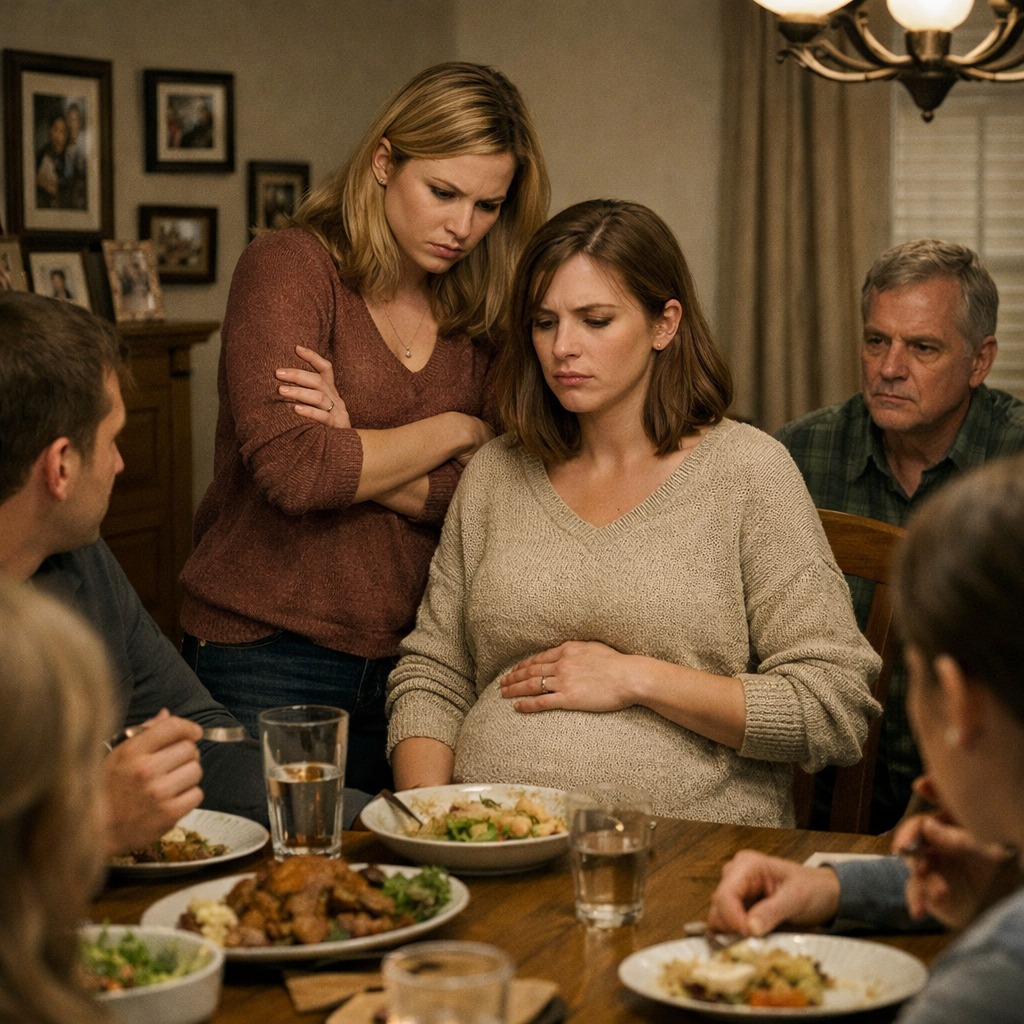
“You think this is over?” she shrieked. “You don’t even know about the pills in the punch bowl!”
The room froze.
Then erupted.
People shoved cups away. A woman gagged. Someone ran for the bathroom.
Two uncles rushed toward the punch table like their bodies moved before their brains caught up.
Evan’s arm went tight around my waist, pulling me backward instinctively.
My heart hammered so hard I thought I might pass out.
Then sirens.
Not the dramatic kind at first—just the distant wail getting closer.
And suddenly, my parents’ baby shower turned into a crime scene.
Police arrived fast—two officers at first, then more. Paramedics pushed in with bags. Someone was sobbing in the corner.
An officer shouted, “Everyone who drank the punch—stay here! Do not leave!”
A paramedic dipped a test strip into the punch. His face stayed neutral, but he still poured samples into containers, sealed them, labeled them.
Aubrey was thrashing, trying to break free as an officer held her by the arm.
And as she fought, her dress shifted.
The fake belly—smooth silicone under fabric—peeled away from her skin and dropped halfway down her legs like a costume piece falling off stage.
The room went silent in a new way.
A horrified, stunned silence.
My mom made a sound like an animal in pain.
My dad’s face went gray.
Aubrey screamed louder, as if volume could fix physics.
Two officers moved quickly, one grabbing Aubrey’s arms, the other stepping toward the punch table while speaking into his radio.
“Possible contamination threat,” he said, voice clipped. “Requesting additional units.”
A female officer—the one in charge—walked over to me and Evan with a notebook.
“Ma’am,” she said firmly, “I need you to tell me what happened leading up to tonight.”
Evan squeezed my hand.
My voice shook, but I spoke.
I told her everything—three months of forced secrecy, daily texts, bans from events, lying to friends, being pressured by my parents, the birthday dinner, Ricardo’s confession.
As I spoke, the officer’s pen slowed.
She stopped taking notes for a second and looked at me like she wasn’t just hearing drama anymore.
She was hearing danger.
“Your parents knew?” she asked.
I swallowed hard. “Yes.”
Evan added quietly, “This has happened before with other relatives.”
Ricardo walked over then, face drained, and told the officer he was Aubrey’s husband.
“I have messages,” he said hoarsely. “She planned to blame her fake miscarriage on her sister’s announcement.”
The officer took photos of Ricardo’s phone screen and asked him to forward everything.
And while all of that happened, my mom pushed through the crowd toward the officer like she could still control the narrative.
“This is a mental health crisis,” she cried. “We’ll take her home. Please—no police.”
The officer gently removed my mom’s hand from her arm.
“Ma’am,” she said, calm but unmovable, “your daughter has assaulted property, threatened poisoning, and is in an active crisis in front of multiple witnesses. She’s going on a seventy-two-hour psychiatric hold.”
My mom sobbed harder, begging.
My dad asked if there was “no other option.”
The officer shook her head. “This is for everyone’s safety. Including hers.”
Then my mom turned to me—eyes red, face twisted with rage and grief—and hissed, “This is your fault.”
Evan stepped between us instantly.
“Back off,” he said sharply. “She didn’t cause this. Your daughter did.”
My dad grabbed my mom’s elbow and pulled her away before the officer had to intervene.
Aubrey was strapped onto a gurney because she kept trying to sit up.
Her eyes found mine.
She screamed my name like it was a curse.
Then the ambulance doors shut.
No sirens.
Just flashing lights washing the yard in red and blue.
And as it pulled away, I stood there shaking, one hand on my belly, feeling the baby move inside me like a reminder:
You’re still here.
You protected us.
We got home that night and I couldn’t sleep.
My phone buzzed nonstop by morning—texts, calls, voicemails.
Half the family was “checking in.” The other half was blaming me for “triggering” Aubrey.
My aunt sent a long message about fertility struggles and compassion.
Cousin Maria—whose wedding I’d skipped—texted:
I wish you told me the truth. I would’ve had your back.
I stared at that message for a long time.
Then I put my phone face down and whispered, “Me too.”
At noon, Ricardo called asking to come over.
He arrived looking wrecked and told us—again, slower this time—about the pattern, the cousins, the cover-ups.
Evan took notes while Ricardo spoke, because that’s what my husband did when something mattered: he turned chaos into a timeline.
When Ricardo left, Evan looked at me and said, “We’re not dealing with this alone anymore.”
He opened his laptop and said, “Restraining order. Lawyer. Security plan for the hospital. Everything.”
I nodded.
Because the truth had finally settled in my bones:
Stopping the secrecy didn’t create the crisis. It revealed it.
And now there was only one question left:
How do you rebuild a life when your family’s love came with conditions—and your sister’s condition was a threat?
The next morning, the world tried to pretend nothing had changed.
My body didn’t get the memo.
I woke up with my jaw clenched so hard my teeth ached. My stomach was tight—not morning sickness tight, but that post-adrenaline tight where your body is still bracing for impact even though the room is quiet.
Evan was already up, standing in the kitchen in sweatpants, staring at my phone like it was a live grenade. It kept lighting up, vibrating across the counter in small angry bursts.
“Don’t look yet,” he said softly.
“I have to,” I whispered.
Because that’s the thing about families like mine—silence is never neutral. If you don’t respond fast enough, they write your response for you.
I picked up the phone and scrolled.
- Mom: Call me right now. We need to fix this.
- Dad: We should meet and talk like adults.
- Aunt Linda: I can’t believe what I saw. Are you okay?
- Cousin Jenna: She’s sick. Don’t be cruel.
- Uncle Mark: Your sister needs help, not judgment.
- Maria: I wish you told me. I would’ve covered for you. I’m so sorry.
And then the ones that felt like swallowing glass:
- Mom: If you had just waited, none of this would’ve happened.
- Mom: You triggered her.
- Mom: How could you embarrass your sister in front of everyone?
I stared at that last one until the words went blurry.
Embarrass.
As if Aubrey’s fake belly falling off during a police struggle was a party trick I’d planned.
Evan took the phone gently from my hand and set it face down.
“Okay,” he said, voice firm but calm. “New rule. We don’t let your mother’s panic become your problem.”

Yo Make również polubił
Czy potrafisz rozwiązać to zadanie matematyczne?
Naleśniki Ziemniaczane: Szybki Przepis na Pyszne, Atrakcyjne Bułeczki
W Wigilię było -10°C, a tata zamknął drzwi wejściowe. Stałem sam na zewnątrz w mroźną noc, otoczony padającym śniegiem… tylko dlatego, że „odważyłem się” odpyskować mu przy kolacji. Zadrżałem, patrząc, jak otwierają prezenty przez zaparowane, pokryte szronem okno, a moje palce powoli robiły się fioletowe. Godzinę później przed domem zajechała czarna limuzyna. Babcia, o której cała moja rodzina zawsze mówiła mi, że nie żyje, nagle wysiadła. Spojrzała na mnie drżącego z zimna, zerknęła na dom i powiedziała tylko jedno słowo: „Zburzyć”.
Nie ignoruj tych małych czerwonych plamek na ramieniu: mogą to być poważne sygnały ostrzegawcze.